
CEE graduate students receive MIT Fellowships for 2025-2026 academic year
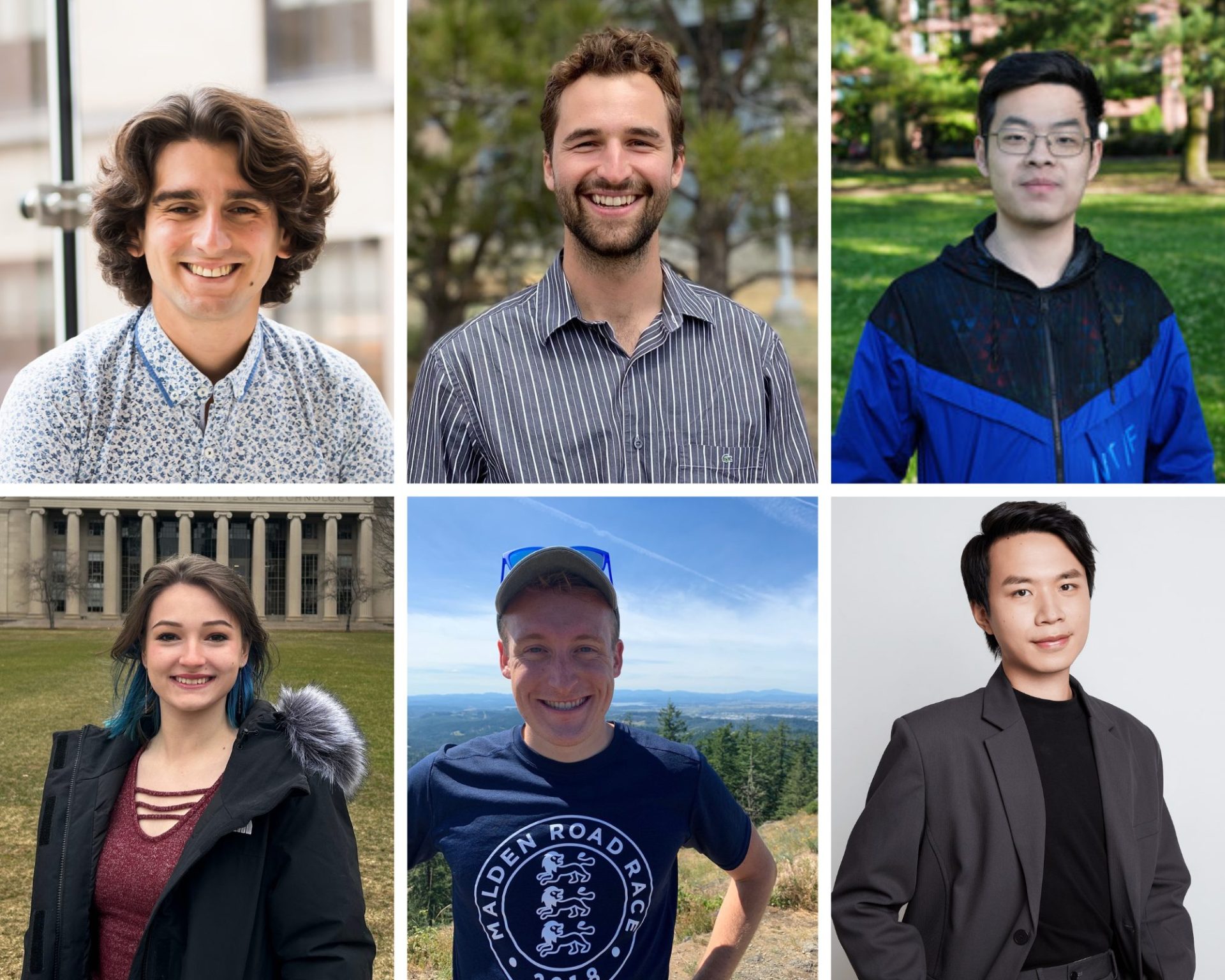
The following students were recognized in the 2025-2026 academic year:
Riccardo Fiorista received the Hugh Hampton Young Fellowship. Riccardo’s research addresses challenges in public transportation systems by advancing understanding of transit accessibility and equity through data driven, co-designed optimization approaches that balance operational efficiency with social justice. Driven by a commitment to social impact, his research aims to equip policy makers and transit agencies with the tools to ensure public transportation systems are efficient, resilient, and inclusive networks.
Ilan Upfal was honored with the TVML Fellowship. In the Howland Lab, Upfal’s work applies fluid dynamics to wind and tidal energy systems to answer questions related to optimal control, prediction, and reliability. He is currently working on a project which models turbines in confined flow conditions (common for tidal turbines) from first principles, which is important for optimizing the design and control of tidal energy turbines. He is also designing a new set of experiments which capture the dynamics of very large flexible wind turbine blades using high pressure wind tunnel experiments. These experiments will improve our understanding of the aeroelastic instabilities of large flexible blades which will reduce costs and improve reliability of wind energy.
Haichen Hu, a recipient of the Angela Leong fellowship, works with faculty advisor David Simchi-Levi, the William Barton Rogers Professor in Energy. His research lies at the intersection of statistics, machine learning, and optimization. In the era of generative AI, his work focuses on the statistical theory and economic foundations of artificial intelligence systems. Through this fellowship, he plans to explore the rigorous evaluation of black-box modern deep leaning models and in contract design for online platforms that incorporate AI-usage disclosure.
Chloe Heitmier received the HEALS fellowship, a highly selective fellowship program that supports 32 exceptional graduate students in the 2025-2026 academic year. Working with faculty advisor Professor Dave Des Marais, this fellowship will support Heitmier’s research examining how rising atmospheric CO2 and different forms of nitrogen alter root exudation in crop plants. By combining hydroponic and soil-based methods, her work reveals how future climate conditions may reshape belowground carbon allocation and plant-soil interactions. These insights are critical for designing resilient cropping systems and managing soil fertility under climate change.
Marc Foster received the Martin Fellowship, which supports MIT doctoral students pursuing sustainability research in a wide array of fields and topics. Working in the Plata Lab, Marc’s research investigates how bacterial communities work together to degrade and consume plastics to inform design of bioreactors and bio recycling strategies.
Dingyi Zhuang received the UPS Fellowship (through CTL). Zhuang works in the MIT JTL-Transit Lab under the guidance of Professor Jinhua Zhao. His research focuses on developing trustworthy AI methods for transportation systems, with an emphasis on improving the reliability of spatiotemporal prediction models used in urban mobility and traffic management. Specifically, he works on uncertainty calibration and graph-based learning techniques that help quantify model confidence and make predictive tools more robust when applied to real-world transportation data. The UPS Fellowship will support his ongoing work to build safer, more interpretable, and more reliable AI models for city-scale mobility analytics.
Share on Bluesky